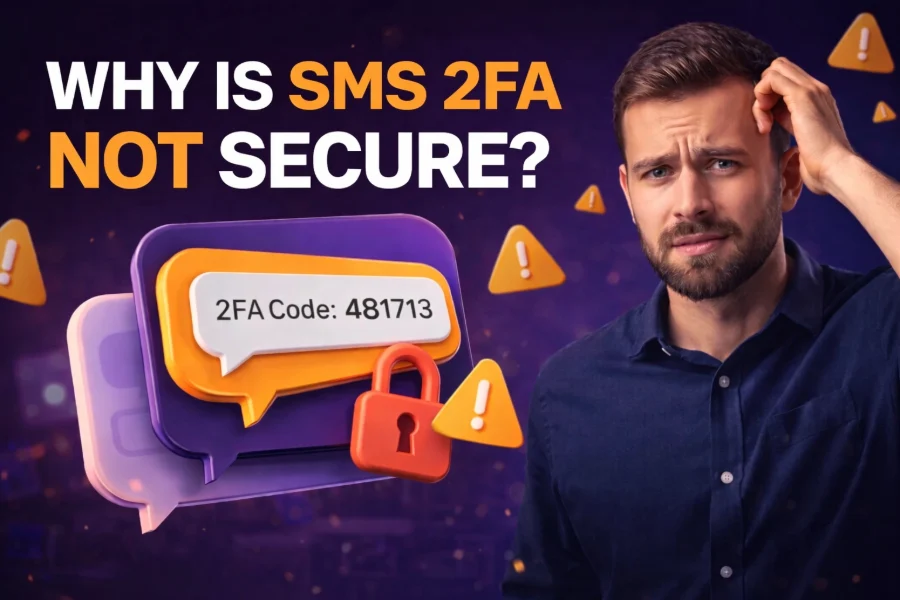
If you have ever asked why is SMS 2FA not secure, you are asking the right question at the right time. Text-message codes still look convenient, but convenience can hide weak points that attackers understand very well.
Once you see how phone numbers can be hijacked, messages can be intercepted, and codes can be stolen through phishing, you will understand why security experts now treat SMS as a fallback instead of a best-in-class defense. Read for more information.
SMS 2FA Was An Upgrade, But It Is No Longer Enough
SMS 2FA became popular because it was much better than relying on a password alone, and that early success made many businesses treat it like a complete answer. Platforms such as sms automation that grows ecommerce revenue shows how useful text messaging can be for customer communication and revenue growth, but marketing value is very different from login security strength. That difference matters because a channel can be excellent for reminders, offers, and updates while still being too exposed for high-risk authentication.
You should think of SMS 2FA as a middle step in the security journey, not the final destination. It raises the bar against casual attacks, but it does not give you strong protection against targeted account takeover, real-time phishing, or telecom-based abuse. That is why modern security teams increasingly prefer phishing-resistant methods such as passkeys, security keys, and authenticator apps.
A Phone Number Is Not Strong Proof Of Identity
Many people assume a phone number belongs securely to one person, but that assumption is weaker than it looks. Your number depends on a mobile carrier, account records, support procedures, and recovery workflows, which means other people and other systems can affect your access. If an attacker can convince a carrier to move your number or route your messages elsewhere, the code stops proving that you are really you.
This is the core weakness behind the question why is SMS 2FA not secure. The code may be temporary, but the delivery system behind it is not fully under your control. When identity proof depends on a phone line that can be reassigned, forwarded, or socially engineered, you are not using a truly locked-down second factor.
SIM Swapping Turns Your Number Into Someone Else’s Key
SIM swapping is one of the clearest examples of how SMS 2FA fails in the real world. In a SIM-swap attack, a criminal tricks or pressures a carrier into moving your number to a new SIM card, which gives that person your calls and text messages. Once that happens, the one-time code meant for your device lands in the attacker’s hands instead.
The same kind of decision-making you use when comparing tools such as best AI content generators should also apply to security choices, because feature lists mean little if the underlying system is easy to abuse. If your login factor can be redirected by a phone-company process, it is not as trustworthy as a factor that stays bound to your device or your biometric approval. That is why SIM swapping remains one of the strongest arguments against using SMS as your main authentication method.
SMS Messages Can Be Intercepted, Delayed, Or Rerouted
A text message feels private because it appears on your screen, but the path it takes is not as locked down as most users think. SMS travels through telecom systems that were not designed around today’s phishing, fraud, and account-takeover threats, so interception and routing abuse remain real concerns. Even when an attacker does not intercept a message directly, delivery delays can still break the user experience and push people toward unsafe workarounds.
The evaluation mindset behind 15 uses of content generator tools is useful here because it focuses on what a tool can actually do well and where it creates risk or friction. SMS works well for broad communication, but secure authentication demands stronger control, faster reliability, and less exposure to network-level problems. Once you separate messaging convenience from identity assurance, the weakness of SMS becomes much easier to spot.
Phishing Can Defeat SMS 2FA In Real Time
One of the biggest reasons why is SMS 2FA not secure is that phishing sites can steal the code while you are still typing it. An attacker creates a fake login page, captures your password, asks for the texted code, and relays both pieces of information to the real site before the code expires. In that moment, the attacker does not need to break encryption or own your phone because you hand over the code yourself under pressure.
This is why security experts now prefer phishing-resistant methods. A passkey or hardware security key is tied to the real site, which makes fake pages much less effective. SMS codes, by contrast, can often be copied, forwarded, and reused with alarming speed.
Social Engineering Attacks The Human Weak Point
Cybersecurity is rarely just about code because people sit inside every important process. Support agents, mobile carrier staff, help desks, and even you can be manipulated through urgency, fear, or convincing personal details. When an attacker can talk a real person into changing account records or bypassing normal verification, SMS 2FA becomes easier to break than many companies expect.
This human layer is one reason text-based verification ages poorly as threats mature. You might lock down your password policy, but a determined attacker may simply call a support line and pretend to be you. If the system behind the phone number can be socially engineered, the second factor is not truly independent.
Malware And Notification Previews Create Extra Exposure
Your phone can also leak SMS codes in quieter ways that users often overlook. If malware is present on a device, or if lock-screen previews display verification texts openly, a criminal may gain access without ever needing a complex telecom attack. That means the weakness is not only in the message network but also in how messages are stored, displayed, and read.
This matters because many people treat SMS 2FA as invisible background protection. In reality, the code often appears in plain sight at exactly the moment it is most valuable. A stronger factor should reduce exposure, not place the critical secret in a format that can be copied quickly from a compromised or unattended device.
SMS 2FA Can Fail Legitimate Users Too
Security that frustrates real users eventually creates unsafe behavior. When text codes arrive late, do not arrive at all, or go to a number you no longer control, people start looking for shortcuts, weaker backups, or repeated resets that create new openings for attackers. A defense that fails under normal conditions can quietly weaken the whole account-protection system.
This is another reason businesses are rethinking SMS. It is not only about stopping sophisticated criminals, but also about reducing support tickets, login abandonment, and risky recovery habits. Better authentication methods improve both safety and usability at the same time.
Better Options Now Exist For Most Users
You are no longer stuck choosing between passwords alone and texted codes. Authenticator apps generate time-based codes on the device, push approvals add contextual prompts, hardware security keys resist phishing, and passkeys can tie login approval to biometrics or device-bound cryptography. These methods reduce the exact risks that make SMS weaker, especially routing abuse and real-time code theft.
Platforms like Viewifi also show the importance of improving visibility and control when managing digital interactions. Not every replacement is perfect for every business, but several are clearly stronger than SMS. The best choice depends on your audience, risk level, and technical setup. Even so, the direction is clear: modern authentication should bind approval more tightly to the user and the real service.
Passkeys And Security Keys Lead The Pack
If your goal is strong account protection, passkeys and hardware security keys deserve serious attention. They are designed to resist phishing by working only with legitimate domains, which blocks one of the most common ways attackers beat SMS 2FA. They also reduce reliance on shared secrets that can be copied from one screen and pasted into another.
For everyday users, passkeys may feel surprisingly simple because they often use the device you already trust. For higher-risk accounts, security keys add a powerful layer that is difficult to intercept or socially engineer. In both cases, the system proves more than possession of a phone number.
How You Can Move Away From SMS Without Confusing Users
A smart migration plan does not shame users for choosing the default option that many platforms once promoted. Instead, you explain the risk in plain English, offer a better method during routine login or settings changes, and keep SMS only as a temporary backup while people transition. That approach protects adoption, reduces friction, and improves security over time.
You should also segment by risk. Admin accounts, finance tools, customer databases, and high-value user accounts should move first because the damage from compromise is greatest there. Once the higher-risk group is protected, you can expand the rollout with better support and clearer instructions.
When SMS Still Has A Limited Role
There are still situations where SMS can serve a purpose, but that purpose should be narrow. It may work as a fallback for low-risk accounts, for users who cannot yet adopt stronger methods, or as a temporary bridge during onboarding. Even then, you should treat it as the least preferred option, not the premium option.
That distinction helps answer to why is SMS 2FA not secure without turning the issue into an oversimplified yes-or-no debate. SMS is not useless, but it is easier to intercept, trick, reroute, and abuse than stronger alternatives. Once better tools are available, settling for SMS as your primary defense becomes harder to justify.
Conclusion
So, why is SMS 2FA not secure in a modern threat environment? It is not secure enough because the code depends on a phone number that can be socially engineered, rerouted, intercepted, phished, exposed on a device, or delayed when you need it most.
If you want stronger account protection, you should move toward authenticator apps, passkeys, push approval, or hardware security keys, because those methods do a much better job of proving that the real you is logging in and that the request is happening on the real site.